
Why adaptive contracting fails in predictable ways
Stop trying to change your people. Change what they are protecting.

For decades, the vast majority of contract formation and management rested on the assumption that enough analysis at the outset could buy enough certainty for delivery. Define the requirements, allocate the risks, assign responsibilities, and manage performance through compliance with the agreed framework. This led to the dominant use of contract standards and templates as perceived sources of business efficiency and management of risk. In markets that changed slowly, it worked well enough. But those conditions are gone. Today's organizations operate amid uncertainty, disruption, and interdependence, and the assumptions a contract is built on often begin to erode before it is even fully implemented.
Across industries and governments, organizations are reaching for adaptive contracting – more flexible governance, relational mechanisms, outcome-based agreements – to cope with conditions that will no longer hold still.
Yet the initiatives keep disappointing in the same way: we talk about adaptability and resilience, but the behaviors do not change. At root, this is a design problem rather than a contract problem, and that is where we begin.
Adaptive contracting fails in predictable ways because organizations try to solve a design problem with generalized statements of intent and motivational tools. They are asking functions built to prevent failure to become engines of adaptation, without redesigning what those functions are there to protect, how they work together, or what the contract itself is meant to do.
The cost is real. WorldCC research puts average contract value erosion at 8.6%, down from a pandemic peak of 10.9%, though still close to a tenth of expected value lost on the typical agreement. And the pressure is building. In the 2025 Benchmark, 87% of organizations report operating at heightened uncertainty, driven by factors such as geopolitical and market instability, internal anxiety about jobs and relevance, and the disruption of AI; and these forces neither arrive in sequence nor keep to a predictable timing. Meanwhile, confidence in contracts as tools for operational guidance has fallen from 68% to 50% since 2017, and as instruments for supporting a business relationship from 82% to 67%. The documents get signed, the world moves, and the instrument meant to guide performance is increasingly trusted to do neither.
The standard diagnosis is resistance to change, and the standard remedy is change management: communication cascades, training, transformation messaging. Decades of well-funded programs later, the same frictions persist: key functions brought in too late, the use of templates nobody trusts, escalations that arrive after the damage has been done. When a remedy fails this consistently, the fault usually lies in the diagnosis rather than the patient. The failure lies in what your people have been told to protect, not in the people themselves.
Who is in the chair?
Start with an honest look at the cognitive composition of the commercial function or functions. As a working model, picture a 25/50/25 distribution: roughly a quarter of professionals naturally comfortable with ambiguity and adaptive judgment, half who adapt well when conditions support them, and a quarter deeply oriented toward caution, consistency, and the prevention of error.
Research on the Adaptability Quotient (AQ), measured across dimensions such as mental flexibility, resilience, and the capacity to unlearn, consistently finds only around a quarter of professionals scoring high. More striking, limited testing within the WorldCC community suggests the figure among contracting professionals may be closer to 15%, significantly below the general population. That is not an indictment of the professionals; it is what you would predict. A function that has spent decades selecting, training, and rewarding for caution will, over time, concentrate the cautious. The precise proportions matter less than the structural fact: in any procurement, legal or contract management function, the adaptive demand falls on a population mostly optimized for something else.
The preventist
Go one layer deeper, and caution turns out to be more than a habit; it is an identity. These professionals are there to stop bad outcomes. They are rewarded for overseeing compliance and avoiding loss, not enabling adaptation or optimizing mutual outcomes. So when leadership announces transformation, a preventist hears exposure rather than opportunity, a request to relax the very instincts that define their professional worth.
The organizational theorist Karl Weick found the sharpest image for this in the 1949 Mann Gulch fire. Thirteen wildland firefighters died on a Montana hillside, several still carrying their heavy tools – shovels, saws – as the fire closed the distance they needed to outrun. Dropping the tools would have bought the seconds that meant survival. They could not do it. Weick's point was not foolishness on their part, but that under extreme pressure the tools that define your competence become indistinguishable from your identity. Letting go feels like ceasing to be who you are.
The preventist under pressure is holding the template and protecting the process the way those firefighters held their shovels.
The adaptability research echoes this in numbers: of all the AQ dimensions, the one on which workforce testing most consistently shows weak scores is unlearning, the capacity to let go of past mastery. The shovels, the template, and the unlearning deficit are the same finding in three registers. It tells you why exhortation fails: "drop your tools" is the instruction that is hardest to follow at the moment it matters most.
There is a second cost, visible from the outside. Because these functions are seen as advisory, there to sense-check and validate rather than to create, they are brought in late, to ratify decisions rather than shape them. The familiar complaint that legal arrives too late is real, but it is not legal's alone; it is the common fate of every function cast as a brake rather than an engine. Lateness is what the organization's picture of these functions reliably produces.
The mechanism: what unclear goals do to a brain under pressure
So what actually flips a capable professional into their most defensive pattern? A 2025 study in the International Journal of Business Communication (Sopow & Sushkova), analyzing survey data from 189,584 Canadian public service employees, tested twelve widely recommended change-management factors against whether employees judged change to be well managed.
Only four of the twelve carried real statistical weight. Together, those four explain 87% of the difference between departments where change was judged well managed and departments where it was not. One of the four dominated: how well the organization communicated its mission, vision and goals. That factor alone accounted for 53.43% of what the model explained, more than the other three combined. Of everything that separated the departments that managed change well from those that did not, more than half came down to a single question: did people understand what they were trying to achieve together? Training programs, feedback, tools, collaboration initiatives, all the usual remedies mattered far less.
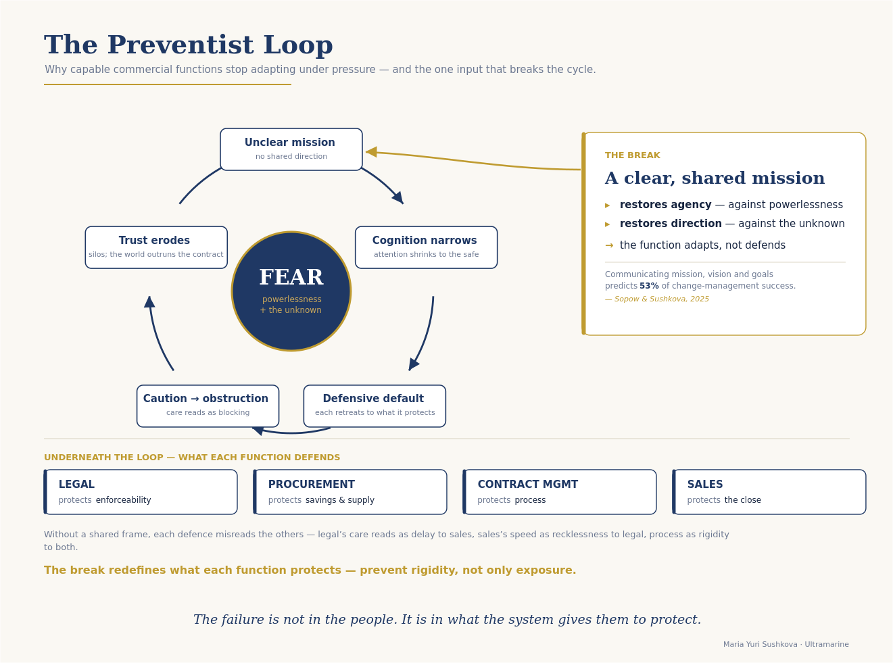
Why would clarity of purpose dominate so completely? Because of what its absence does to a mind under pressure. Decision researcher Gary Klein showed that experts under time pressure do not weigh options, they pattern-match, reaching for the most rehearsed, most identity-consistent response. That is normally a strength; it is what expertise is. But for a preventist with no shared goal in view, the most rehearsed pattern is the defensive default. They are not choosing caution over adaptation; caution is being served up before adaptation ever reaches the table.
The study points to the deeper reason: the power of mission clarity lies in dissolving the two ingredients of the fear of change, powerlessness and the unknown. Fear narrows cognition; clarity widens it. A clear, shared sense of where the organization is aiming to go is cognitive infrastructure, a load-bearing wall for judgment under pressure. If it is not there, your most capable people will reliably produce your most conservative behavior. They are not failing; they are functioning exactly as designed, in the absence of the one input that could redirect their competence.
Clarity is the grounding, but it is not the whole job. New behavior does not a
rrive the moment the mission becomes clear. Research on habit formation offers the caution: in Lally's 2010 study, everyday behaviors took a median of 66 days of repetition in a stable context to become automatic, with a range running from 18 days to more than 250. Organizational behavior is considerably more complex than drinking water after breakfast, but the direction of travel is the same. Embedding takes longer than anyone plans for.
This is where design does the work that exhortation cannot. What makes a new behavior repeatable is the cue and the consequence, not willpower: what gets measured, what gets escalated, what gets rewarded. Change those and you have changed the conditions under which repetition happens. The discipline is then to hold them steady through the first pressure, long enough for the new pattern to become the default. Deviance normalizes through repetition. So does adaptation.
This is also where inter-functional mistrust comes from. Without a shared frame, legal's careful language reads as delay to sales; sales' urgency to close reads as recklessness to legal; and procurement and contract management's process discipline reads as rigidity to both. Nobody is acting in bad faith. Everybody is operating with a narrowed horizon and no shared goal to widen it, and the contract, built on fixed assumptions, hardens the loop.
The early warning
By the time failure appears on an executive dashboard in the form of slippage, cost overrun, or dispute, the system has been deteriorating for some time. Decay accumulates the way safety researchers have long described: each small deviation that produces no immediate failure becomes the new normal. The workaround becomes standard practice. Late involvement of legal, procurement, every careful function, becomes routine. Value erosion is rarely one visible failure; it is a thousand normalized compromises.
The most revealing signal, though, is in the people rather than the process. A March 2026 WorldCC survey of UK commercial and contract professionals found that roughly 48% are actively reconsidering their role, their employer, or their career path. What makes the figure telling is the reason behind it, which is not pay. The drivers are uncertainty about what AI means for their work, anxiety about whether their skills will keep their value and, above all, the absence of any clear vision from their organizations about where the profession is heading. It is the two ingredients of the fear of change, powerlessness and the unknown, made visible as an exit rate. These are not people who have lost confidence in themselves; they have lost confidence in the system around them, and the 53.43% finding is why. A profession that cannot articulate its purpose during disruption will lose many of the people it most needs to navigate it. And the ones who leave first are usually those closest to operational reality: the people who feel where process has overwhelmed judgment, where governance produces delay instead of decisions, where the contract has drifted from the outcome it was meant to serve. Their departure costs more than experience; it removes the organization's earliest warning system.
This is the canary. They are not causing the danger; they are revealing it, earlier than any instrument on the dashboard, and in many cases they are not a retention problem to be solved with a salary review. They are a diagnostic signal. If the only thing you can measure is the smoke, you will consistently miss the fire already starting. What they are showing is not resistance: personal enthusiasm for AI runs well ahead of confidence that organizations know what to do with it. People are not refusing to change; they are waiting to be told where they are going. The risk is not that your most capable professionals reject the future, but that they embrace it faster than their organizations do and leave to find the clarity, autonomy, and purpose theirs could not give them.
The gold in the hinges
Put the pieces together and they form a system, not a list. A function whose composition concentrates caution; an identity built on prevention; a mechanism by which unclear goals convert that caution into mistrust; and warning signals nobody is instrumented to see. Like any system, the place to intervene is the logic that generates the behavior, not the surface behavior or a search for missing skills. That logic is a definition, the definition of what protection means.
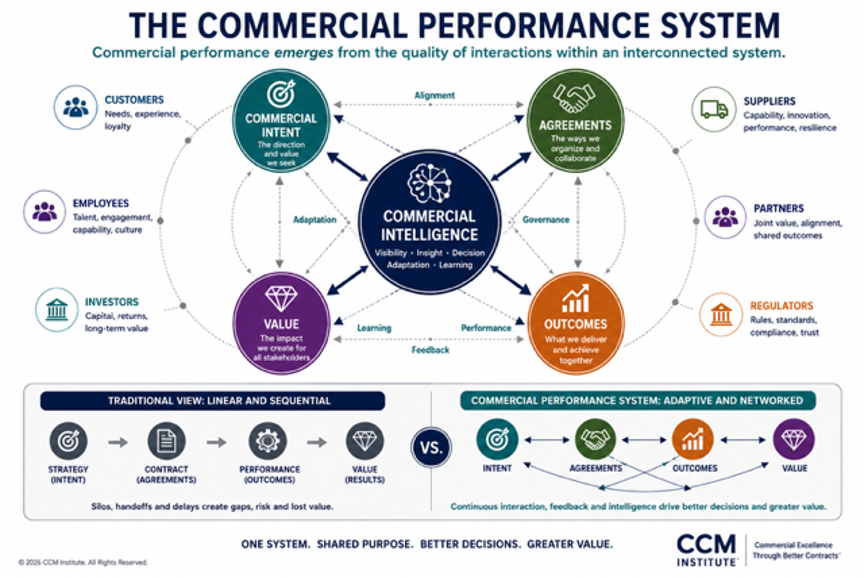
Today, protection means legal defensibility, cost control, compliance, the avoidance of measurable error. All remain legitimate, but no longer sufficient. Indeed, their sustained focus contributes to many of the problems we are trying to avoid: we create the very conditions in which the things we most want to prevent become prevalent.
The gold here is not in the contract but in the capacity to adapt while the contract is live. The hinges between functional hand-offs – legal to procurement, pre-award to post-award, the contract to the business decision it serves – are where adaptation either happens or doesn't. And whether it happens depends entirely on what the people working those hinges believe they are there to protect. A preventist with no clear mission will protect process, because process is the only scaffold available. A preventist with a clear mission, and governance that makes adaptation legitimate and measurable, can protect something far more valuable: the relationship's capacity to respond.
Do not aim to change the people. Change what they consider important.
Four moves follow.
- First, redefine protection to include the prevention of rigidity. Legal exposure is a loss; so is the delay, workaround, and erosion caused by inflexibility, yet only one currently counts as risk.
- Second, treat mission and goal clarity as a governance input, not a communications task. The 53.43% finding is not about inspiring language; it is about the cognitive scaffolding that lets capable people exercise judgment instead of retreating to defaults.
- Third, give the hinges deliberate architecture. Early alignment, relational charters, clear roles, and reporting designed to anticipate issues rather than record failures: the operating conditions under which a preventist's instincts become an asset.
- Fourth, measure what reveals adaptation, not just what records failure. Early-involvement rates, escalation patterns, template deviations, and whether the people who know how the work really gets done are staying or leaving.
None of this asks commercial professionals to be less careful. Their discipline exists because commercial mistakes are expensive, and that discipline is worth keeping. The redesign task is to give them something better to be careful about, and the cognitive infrastructure to be careful about it well. Adaptive contracting fails not because your people resist change but because they are succeeding, brilliantly, at the wrong assignment. Change the assignment.